

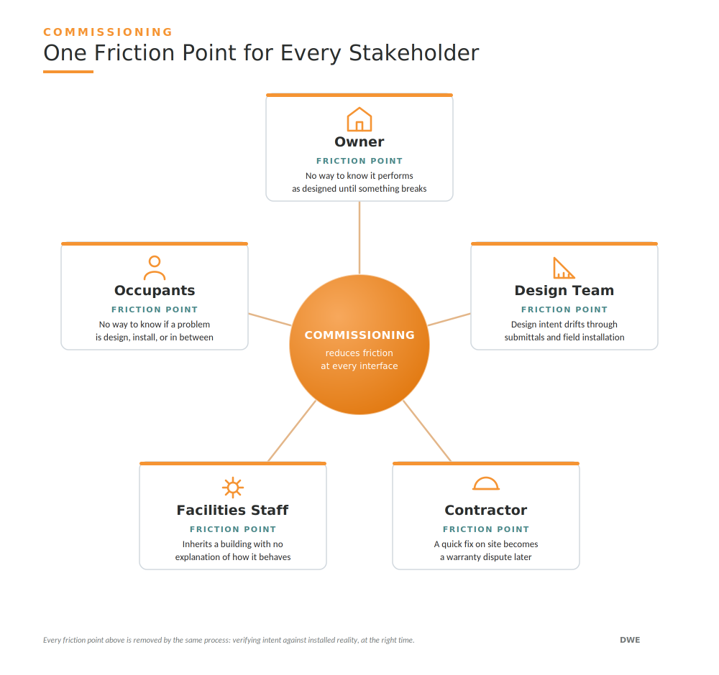
Every construction project generates friction: between design intent and installed reality, between one trade’s schedule and the next, between a facilities team and a building whose systems no one fully explained, between an owner’s budget and a punch list that keeps growing after occupancy.
Commissioning’s job is reducing that friction, at every interface where one party’s success depends on another party doing their part correctly. Done well, it doesn’t create winners and losers among the owner, design team, contractor, and facilities staff. It removes the friction each of them would otherwise absorb.
This isn’t a marketing claim. It’s a conclusion supported by one of the largest datasets assembled on commissioning outcomes: a peer-reviewed meta-analysis of more than 1,500 North American buildings, led by Lawrence Berkeley National Laboratory (LBNL) with the Building Commissioning Association (BCxA).
How DWE Delivers Commissioning
DWE’s process is built around removing friction at each of the points this article covers, applied consistently across K-12, healthcare, and public-agency projects:
- Design and sequence-of-operations review, aligned to ASHRAE Guideline 36 and Title 24 Part 6, before drawings go to bid
- Functional performance testing of installed equipment and control sequences during construction
- Formal issue tracking, with corrected items retested and outstanding items clearly documented through turnover
- Facilities team training and O&M documentation turnover, with operations staff invited to observe functional testing so they inherit working knowledge, not just paperwork
A recent example: during design-phase commissioning for an RUHS HVAC replacement project, DWE identified several gaps in the proposed control sequences, including incomplete air-handling-unit operation, undefined low-temperature protection, an unclear exhaust-fan interlock, and insufficient economizer, demand-control ventilation, and chilled-water pump sequencing. Identifying these issues before construction gave the project team an opportunity to clarify the design before controls programming, installation, and functional testing, when corrections would have become substantially more difficult and expensive.
The Owner: A Fast Payback With a Strong Track Record
The friction: an owner sinks capital into a building with no reliable way to know whether it performs as designed until something breaks, a utility bill comes in high, or an occupant complains.
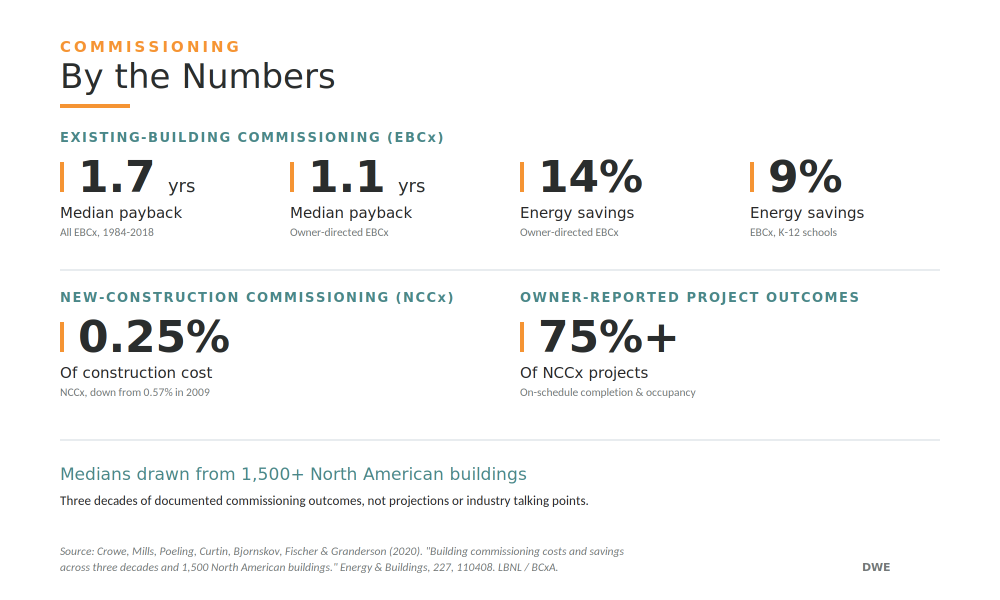
1.7 years. That’s the median simple payback for existing-building commissioning (EBCx) across the full 1984-2018 dataset, with most projects landing between 0.8 and 3.5 years.
1.1 years. That’s the median EBCx payback when an owner engages a commissioning authority directly, outside a utility rebate program, the model closest to how DWE typically delivers Cx, with median energy savings of 14 percent in that scenario.
This compares favorably with many other capital investments an owner might consider for an existing building. Several take longer to break even, and few come with a comparably large body of evidence behind them.
For new-construction commissioning (NCCx), the cost side has also improved: median commissioning cost fell from 0.57 percent of total construction cost in the 2009 study to 0.25 percent in the 2018 update.
K-12 owners get a sector-specific EBCx figure: a median energy savings of 9 percent.
61 percent. For many owners, the opportunity is larger than these medians suggest: the same market survey found that most existing buildings entering EBCx had been rarely or never commissioned before. For most owners, EBCx isn’t a tune-up of a system that was once dialed in. It’s the building’s first verification.
That matters for exactly the building stock DWE works in most: decades-old school campuses and public facilities designed before commissioning was standard practice. For many of these buildings, the payback figures above aren’t measuring marginal tuning. They’re measuring what happens the first time anyone checks at all.
The Design Team: The Cheapest Point to Remove Friction
The friction: a design intent that’s correct on paper drifts through submittals, substitutions, and field installation, until the engineer is blamed for a system that never matched the drawings. By the time that gap surfaces during a functional test, it’s already been designed, drawn, submitted, fabricated, and installed, far more costly to fix than catching it before a drawing went to bid.
25 percent. In the 2018 BCxA/LBNL Value of Commissioning Market Survey, commissioning providers reported that roughly a quarter of all new-construction commissioning (NCCx) issues were discovered during the design phase, before construction began.
Design-phase commissioning, developing the Owner’s Project Requirements, reviewing the Basis of Design, checking sequences and constructability before bid, is already part of roughly 60 percent of NCCx projects, per the same survey. The friction often isn’t whether commissioning reviews the design. It’s whether that review changes anything.
46 percent. That’s how often, per the same provider-reported survey, design review comments actually made it into the contract documents before bid. Just under half the time, a flagged issue still reached construction anyway.
Left unresolved, sequence and design issues get corrected during acceptance instead, at higher cost and greater schedule risk. DWE closes that gap by tracking every design review comment to resolution, confirming each one is either incorporated into the contract documents or explicitly addressed before bid, rather than left to chance.
Verification doesn’t stop at design review. Commissioning also catches gaps during construction, while the design team is still engaged and can respond, rather than months after occupancy. A control sequence that reads correctly on paper doesn’t always behave correctly in the field; functional testing during construction is what confirms it does.
The Contractor: Fewer Surprises During the Warranty Period
The friction: an issue that would have been a quick fix while the crew was on site becomes a scheduled truck roll and a warranty dispute months after the contractor has demobilized.
90 percent. In the same survey, owners on NCCx projects reported the schedule stayed on track because issues were caught and corrected earlier. The same survey found 79 percent reported on-schedule occupancy, 77 percent reported design improvements, 74 percent reported better team coordination, and 56 percent reported fewer warranty calls and change orders.
The mechanism: functional testing during construction, paired with formal issue tracking and retesting before turnover, catches problems while trades are still mobilized. Found on site, it’s a punch-list item. Found after turnover, it’s a liability conversation.
Facilities and O&M Staff: Inheriting a Building That Actually Works
The friction: a facilities team inherits a building with no real explanation of how its systems are supposed to behave, then spends years reverse-engineering that knowledge one nuisance call at a time.
Facilities teams live with a building long after the design and construction teams have moved on. DWE’s approach extends past the O&M binder: facilities staff are trained on the specific sequences and equipment installed at their site, participate in functional testing, and get seasonal testing scheduled so both heating-mode and cooling-mode operation are verified rather than whichever mode construction happened to finish in. DWE remains engaged during the warranty period so operational issues can be documented, investigated, and routed to the appropriate project team member.
Occupants: Comfort and Air Quality, Verified Rather Than Assumed
The friction: occupants experience the gap between design intent and reality directly, as a room that never quite feels right, with no way to know whether the problem is the design, the installation, or something in between.
Commissioning’s biggest impact on occupants is one they rarely see directly: verified ventilation rates, confirmed pressure relationships in critical spaces, and temperature control checked against setpoint rather than assumed. In behavioral health and healthcare facilities, where pressure relationships are a patient safety issue, functional testing confirms a room does what its design was supposed to do.
The Bottom Line
Every stakeholder has a friction point where their success depends on someone else getting something right, without a reliable way to verify it happened. For existing buildings, that verification typically pays back in 1.1 to 1.7 years. For new construction, roughly a quarter of all issues get caught in design instead of the field. The design team gets intent verified instead of assumed. The contractor resolves issues on site instead of after demobilization. Facilities staff inherit training and documentation instead of guesswork. Occupants get a verified space instead of a hopeful one.
Less friction, at every phase and every interface, backed by data DWE puts into practice on every project.
If you are an owner, developer, or facilities director evaluating whether commissioning belongs in your next project or capital plan, Design West Engineering would welcome a conversation.
Connect with our team at designwesteng.com or call (909) 890-3700.