
Examining the Value of Code Compliance Versus LEED Certification in California’s Sustainable Building Landscape
Introduction: Code Compliance or Green Building Certification?
California’s 2025 Energy Code (Title 24, Part 6) has architects and developers asking: If we meet code, do we still need LEED? With electrification, solar readiness, and commissioning now mandatory, the baseline for sustainability is higher than ever. However, LEED v5 introduces performance accountability, carbon tracking, and grid interactivity that go beyond compliance.
The central question is whether California’s rigorous 2025 standards make LEED redundant or whether LEED still represents the next frontier of building performance.
California’s 2025 Energy Code: A New Baseline for High Performance
The 2025 update, effective January 1, 2026, pushes further toward electrification, efficiency, and grid harmonization.
- Heat Pumps as the Default: The prescriptive path now makes electric heat pumps the baseline for HVAC and water heating, effectively phasing out gas for most new buildings.
- Electric-Ready Infrastructure: Even gas-based designs must include conduit and wiring for future electrification.
- Solar and Battery Readiness: Solar PV is required on virtually all new buildings, with many also needing battery storage or at least pre-wiring for it.
- Demand Flexibility: Building controls must be capable of demand response—adjusting loads based on grid conditions.
- Ventilation and IAQ: Strengthened standards improve indoor air quality and filtration.
- Commissioning: CALGreen continues to require commissioning for nonresidential buildings over 10,000 sq.ft., ensuring that installed systems perform as designed.
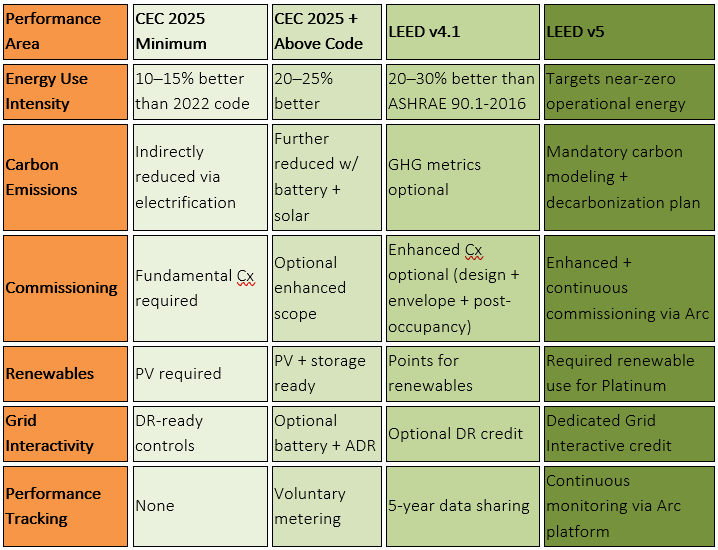
The 2025 Energy Code establishes a high-efficiency, predominantly electric, solar-powered baseline. But does this make it “LEED-equivalent”? Not quite, because LEED brings accountability, carbon quantification, and broader sustainability metrics.
LEED v4.1: Optimizing Energy and Commissioning
LEED v4.1 BD+C focuses on measurable energy improvements over ASHRAE 90.1-2016 and integrates both cost and carbon savings. In California, Title 24 already exceeds much of ASHRAE 90.1, meaning code-compliant designs start close to LEED’s performance baseline. However, to earn substantial LEED points, projects must exceed code further through advanced controls, expanded PV systems, or demand response strategies.
- Commissioning Comparison:
- CALGreen (Code): Requires fundamental commissioning, ensuring systems operate as intended.
- LEED Enhanced Commissioning: Adds envelope commissioning, design document reviews, staff training, and a 10-month post-occupancy recheck, creating a deeper quality assurance loop.
LEED v5: Raising the Ceiling with Carbon, Grid, and Performance Accountability
LEED v5, rolling out in 2025, represents a paradigm shift toward outcome-based, carbon-neutral buildings.
- Operational Carbon Prerequisite: Every project must calculate operational carbon and submit a decarbonization plan with measurable reduction targets.
- Electrification Credit: Up to five points for fully electric buildings. It is required for Platinum certification.
- Grid Interaction: Credits reward designs that reduce peak loads and support grid flexibility through storage, smart controls, and demand response.
- Performance Tracking: All projects must report ongoing energy and carbon performance via the Arc platform, linking design intent to real-world outcomes.
- Embodied Carbon and Resilience: New credits address life-cycle material impacts and climate risk mitigation beyond any current code requirement.
LEED v5 projects are fully electric, grid-smart, renewable-powered, and continuously measured for actual carbon performance. Such a level of accountability has not yet been matched by Title 24.
Code vs. LEED: A Side-by-Side Snapshot
Cost, Incentive, and Lifecycle Considerations
- First Cost: LEED adds roughly 1–5 % design + documentation overhead, but may yield 3–6 year payback through reduced operating costs.
- Lifecycle Savings: LEED Gold/Platinum projects often realize 12–18 % lower utility bills and 20–30 % reduced maintenance due to continuous commissioning.
- Incentives: Federal 179D deductions, California IOU rebates, and local green-building grants are frequently tied to LEED or above-code performance.
- Market Value: Certified buildings command higher lease rates and ESG recognition, especially for institutional owners.
When LEED Still Adds Value in California
LEED is worth pursuing when:
- The owner values ESG alignment, market differentiation, or third-party validation.
- The project aims for a holistic sustainability approach covering water, materials, health, and resilience.
- Long-term performance and energy transparency matter to investors or occupants.
- Incentives or institutional requirements call for certification.
Code-only may suffice when:
- The project is small-scale, budget-limited, or short-term hold.
- Local reach codes already exceed Title 24.
- The owner implements sustainability internally without formal certification.
Beyond California: Why LEED Still Matters Elsewhere
Outside California, most states still operate under older IECC or ASHRAE versions, leaving significant efficiency gaps. LEED provides a consistent framework for energy, commissioning, and carbon leadership across all jurisdictions. For national portfolios, LEED ensures uniform sustainability standards and future-proof designs regardless of local policy maturity.
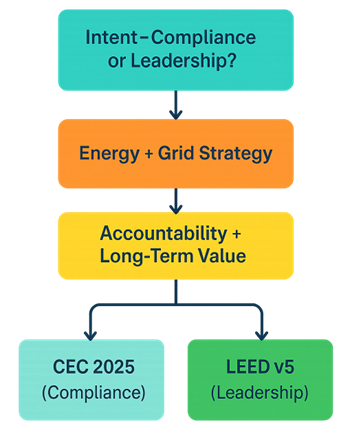
Decision Framework for Owners and Developers
- Intent – Compliance or Leadership?
- If your goal is simple code compliance, CEC 2025 delivers strong results. If you aim to demonstrate environmental leadership or meet ESG goals, LEED v5 is the right tool.
- Energy and Grid Strategy
- For fully electric, solar, and grid-responsive buildings, LEED v5 provides structure, metrics, and recognition that Title 24 compliance alone does not.
- Accountability and Long-Term Value
- If performance tracking, resilience, and asset value matter, LEED’s continuous monitoring ensures your building performs as designed for well beyond final inspection.
Final Thoughts
California’s 2025 Energy Code raises the baseline to an impressive new level. A code-compliant building will be efficient, electric, and solar-powered—attributes once exclusive to green certifications. Yet LEED v5 still defines the aspirational ceiling, adding verification, carbon accountability, and ongoing performance management.
For architects, developers, and owners, the question is no longer “LEED or code?” but “How far beyond compliance do we want to lead?”
California has set the foundation. LEED v5 builds the future.
How Design West Engineering Can Help
Work with Design West Engineering to evaluate your upcoming project according to ways to meet sustainable design benchmarks.
With extensive experience in sustainable building design, Design West Engineering delivers comprehensive expertise in MEP and Fire Protection. Our specialized teams offer fully integrated solutions across Mechanical, Electrical, Plumbing, Fire Alarm, Fire Protection, Low Voltage, Audio-Visual, Security, Dry Utility, PV-BESS, and Commissioning engineering services, ensuring optimal performance, seamless coordination, and clear accountability from initial concept to final occupancy.
Our experts collaborate with architects and developers to create high-performance, electrified, and resilient buildings that not only comply with California’s 2025 Energy Code but also embody the principles of LEED v5 and long-term sustainability leadership.
We are here for the past and future of building together with purpose, passion, and people at the core. Let’s build what’s next together.